I stood in my closet, trying on the fifth pair of jeans that morning. None of them fit anymore.
Not because they were too small overall—my legs were fine, my arms were fine. It was my belly.
That stubborn, frustrating muffin top that seemed to appear overnight and refused to leave no matter what I tried.
Sound familiar? If you're a woman struggling with belly fat, you already know it's different from other weight loss.
Your husband can skip dessert for a week and drop five pounds. Your male coworker does some crunches and suddenly has abs.
Meanwhile, you're eating salads, doing cardio, and that belly fat just... stays.
Here's what nobody tells you:
- losing belly fat as a woman isn't just about eating less and moving more.
- Your hormones, stress levels, sleep quality, and even your age play massive roles.
After years of frustration and finally losing the belly fat that haunted me, I learned that working smarter not just harder is what actually works.
This isn't going to be another article telling you to "just do more sit-ups."
This is real talk about what science says works, what I actually did, and why belly fat is so stubborn for women in the first place.
Why Women Store Belly Fat Differently (And Why It Matters)
Before we dive into solutions, you need to understand why your body loves storing fat around your midsection.
It's not your fault, and it's not because you're doing something wrong.
Women are biologically programmed to store more body fat than men. We need it for reproduction, hormone production, and survival.
But where that fat goes changes throughout our lives, and that's where the frustration begins.
Before menopause, estrogen typically directs fat storage to your hips, thighs, and butt; the "pear shape" many women have.
But as estrogen levels fluctuate (during stress, perimenopause, or menopause), fat storage shifts to your belly instead.
This visceral fat—the kind that surrounds your organs is more dangerous for your health and, unfortunately, more stubborn to lose.
I noticed this shift in my early thirties. Even though my weight stayed roughly the same, my body composition changed.
- My jeans fit differently
- My once-flat stomach started protruding
- My stress levels were through the roof at work
and I was sleeping maybe five hours a night.
That combination high stress plus poor sleep was creating the perfect storm for belly fat storage.
Your body produces cortisol when stressed, and cortisol literally signals your body to store fat around your midsection.
It's a survival mechanism from our cave-dwelling days, but it's incredibly inconvenient when you're trying to fit into your favorite dress.
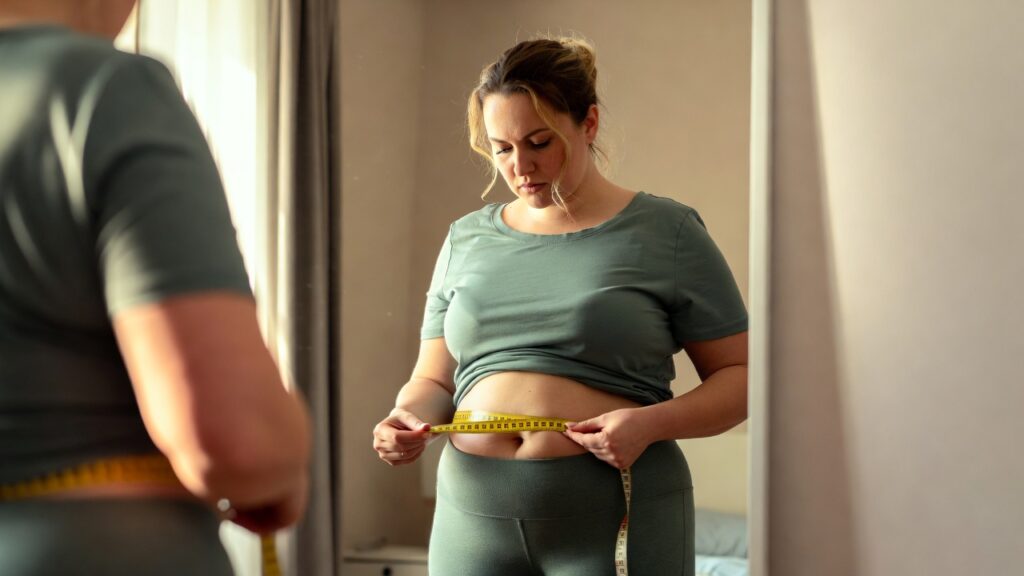
The Cortisol-Belly Fat Connection You Need to Understand
This was my biggest "aha" moment, and it might be yours too.
Cortisol doesn't just make you store belly fat—it actively prevents you from losing it, even when you're doing everything else right.
When cortisol levels stay elevated (from chronic stress, poor sleep, over-exercising, or restrictive dieting), your body thinks it's in survival mode.
It holds onto belly fat like a security blanket, refusing to let go no matter how many calories you cut.
I was exercising hard six days a week, eating 1,200 calories a day, and my belly fat wasn't budging.
Why? Because my body was drowning in cortisol from the stress of intense workouts plus severe calorie restriction plus my already stressful job. I was sabotaging myself with "healthy" behaviors.
The solution wasn't doing more it was doing less, but smarter.
When I reduced my workout intensity, ate more (yes, more!), and prioritized sleep and stress management, the belly fat finally started coming off.
It seemed counterintuitive, but it worked.
This is why crash diets fail for belly fat. Sure, you might lose weight overall, but that stubborn belly area?
It stays because your body is stressed from the restriction. Quality sleep and stress management are just as important as nutrition and exercise when it comes to losing belly fat—maybe even more important.
What Actually Works: The Strategy That Changed Everything
Forget everything you've heard about doing hundreds of crunches or eliminating entire food groups.
Here's what actually works for losing belly fat as a woman, backed by research and my own experience.
Fix Your Sleep First (Yes, Really):
This seems unrelated to belly fat, but it's actually foundational. Poor sleep increases
- Ghrelin (hunger hormone)
- Decreases leptin (fullness hormone
It's a triple threat for belly fat storage.
I was sleeping four to five hours a night for years. Once I prioritized getting seven to eight hours consistently, everything else became easier.
My cravings decreased, my energy improved, and my body finally felt safe enough to release stored fat.
If you're struggling with sleep, understanding the connection between sleep, stress, and your overall health is crucial. Your belly fat might be a sleep problem in disguise.
Create a non-negotiable bedtime routine. Turn off screens an hour before bed. Keep your room cool and dark.
Treat sleep like the powerful weight loss tool it actually is, not something you sacrifice when you're busy.

Eat More Protein (Especially at Breakfast):
Protein does three magical things for belly fat loss
- It increases your metabolism
- Reduces appetite
- Helps preserve muscle while you lose fat.
Women often don't eat enough protein, and it shows in stubborn belly fat.
I started eating 25-30 grams of protein at breakfast instead of my usual toast and coffee. The difference was immediate.
I stopped snacking before lunch, had more energy, and felt more satisfied throughout the day.
Aim for at least 0.8-1 gram of protein per pound of your goal body weight daily. If you want to weigh 140 pounds, eat 112-140 grams of protein per day.
This seems like a lot at first, but it's doable with planning.
Good breakfast options: three-egg omelet with vegetables, Greek yogurt with nuts and berries, protein smoothie with protein powder and spinach, or cottage cheese with fruit.
Starting your day with protein sets your hormones up for fat burning instead of fat storage.
Strength Training Over Cardio (This Was Hard to Accept):
I spent years doing cardio, thinking it was the fastest way to burn belly fat. I was wrong.
Cardio burns calories while you're doing it, but strength training builds muscle that burns calories 24/7, even while you sleep.
Muscle is metabolically active tissue. The more you have, the higher your resting metabolism.
When you lose weight through cardio alone, you lose both fat and muscle, which slows your metabolism.
When you lose weight while strength training, you preserve (or even build) muscle while losing fat.

The Nutrition Strategy That Works (Without Feeling Like Deprivation)
Extreme calorie restriction backfires for belly fat. Your body panics, raises cortisol, and holds onto abdominal fat for dear life.
I learned this after multiple failed attempts at 1,200-calorie diets that left me exhausted, hangry, and still carrying belly fat.
Eat Enough (Yes, Enough):
Calculate your maintenance calories and eat 300-500 calories below that not 800-1,000 below. This creates a sustainable deficit without triggering stress hormones.
For most women, this means eating 1,600-2,000 calories daily, not the 1,200 that diet culture pushes.
I increased my calories from 1,200 to 1,800 and finally started losing belly fat consistently.
It felt wrong at first how could eating more help me lose fat? But my body finally felt safe, cortisol normalized, and fat loss became effortless instead of a constant battle.
Focus on Whole Foods (Not "Diet" Foods):
Ditch the low-fat, sugar-free, processed "diet" foods. They're full of chemicals, artificial sweeteners, and ingredients that spike insulin and increase cravings.
Real food vegetables, fruits, lean proteins, whole grains, healthy fats is what your body recognizes and processes efficiently.
I stopped buying "diet" yogurt and switched to full-fat Greek yogurt. I replaced protein bars with real food.
I ate potatoes instead of "low-carb" tortillas. My digestion improved, cravings decreased, and I actually felt satisfied after meals.
This doesn't mean you can never have treats. It means your foundation should be real, whole foods that nourish your body.
The 80/20 rule applies here: eat well 80% of the time, enjoy life 20% of the time.

Manage Your Carb Timing
You don't need to eliminate carbs to lose belly fat, but when you eat them matters.
Eating most of your carbs around your workout (before or after) helps them get used for energy and muscle recovery instead of being stored as fat.
I moved most of my carb intake to after my morning strength workouts and kept evening meals lighter on carbs, heavier on protein and vegetables.
This simple shift improved my energy during workouts and reduced bloating at night.
This isn't a strict rule it's a strategy. If you workout in the evening, have your carbs then.
The point is matching your fuel to your activity level rather than eating the same macros at every meal regardless of what your body needs.
The Hormonal Factor (Especially for Women Over 35)
If you're approaching or past 35, hormones are likely playing a bigger role in your belly fat than you realize.
Perimenopause can start in your mid-30s, and the hormonal fluctuations wreak havoc on fat storage.
Declining estrogen means fat shifts from hips and thighs to your belly. Progesterone imbalances cause water retention and bloating.
Thyroid issues become more common, slowing metabolism. It's not fair, but it's reality for many women.
I didn't realize I was in early perimenopause until I talked to my doctor about my sudden weight gain around my middle despite no lifestyle changes.
Getting my hormones checked and addressing imbalances made a massive difference.
Consider getting a full hormone panel if you're over 35 and struggling with sudden belly fat gain. Check thyroid, estrogen, progesterone, testosterone, and cortisol.
Sometimes belly fat is a symptom of an underlying hormonal issue that needs medical attention, not just diet and exercise.
Work with a healthcare provider who understands women's hormones.
Solutions might include optimizing vitamin D, managing stress, improving sleep quality, adjusting exercise intensity, or in some cases, hormone replacement therapy.

Lifestyle Factors That Make or Break Progress
Beyond diet and exercise, these lifestyle factors were game-changers for my belly fat loss journey.
Alcohol and Belly Fat:
This was hard to accept, but alcohol is terrible for belly fat. It's processed like a toxin in your liver, which puts all other metabolic processes (including fat burning) on hold.
It also lowers inhibitions around food, disrupts sleep, and adds empty calories.
I was having wine most nights, thinking it was fine because it fit my calories. But alcohol was sabotaging my progress in multiple ways.
When I reduced drinking to weekends only, my belly fat loss accelerated noticeably within two weeks.
You don't have to quit alcohol completely, but reducing frequency and quantity makes a measurable difference.
If belly fat loss is your priority, consider this an area worth examining honestly.
Managing Stress Beyond Exercise:
Exercise helps with stress, but if it's your only stress management tool, you're missing huge opportunities.
I added meditation, journaling, time in nature, and saying "no" more often to my stress toolkit.
The belly fat connection to stress cannot be overstated. Chronic stress keeps cortisol elevated, which keeps belly fat stuck. Managing stress effectively is as important as your nutrition plan.
Find what works for you: yoga, reading, art, time with friends, therapy, breathwork, or simply doing less.
The specific activity matters less than consistently giving your nervous system time to downregulate.
Consistency Over Perfection
The fastest way to lose belly fat isn't the most aggressive plan—it's the one you can stick with long-term.
I tried extreme approaches that lasted two weeks before I cracked. The moderate approach I could maintain for months? That's what actually worked.
Aim for 80% consistency. Four good days out of five. Eight solid weeks out of ten. This creates results that last because you're building habits, not forcing willpower.
Bad days will happen. You'll eat too much. Skip workouts. Sleep poorly. That's life.
The difference between success and failure isn't having zero bad days—it's getting back on track after them without guilt or self-punishment.

The Timeline: What to Realistically Expect
Here's the truth nobody wants to hear: losing belly fat takes time.
Those "lose 10 pounds of belly fat in one week" claims are lies. Real, sustainable belly fat loss for women happens at about 0.5-1% of body weight per week.
If you weigh 150 pounds, that's 0.75-1.5 pounds weekly. Some weeks will be more, some less, some none at all. But averaged over months, consistent progress happens.
I lost about 12 pounds over four months, and most of that came from my belly area. That's three pounds per month, less than a pound per week.
It doesn't sound dramatic, but the visual difference was significant because I was building muscle while losing fat.
The first place you gain fat is usually the last place you lose it. If belly fat appeared first for you, it'll be stubborn to lose. This requires patience and consistency, not extreme measures.
Trust the process. Take progress photos every two weeks. Track measurements, not just scale weight. Notice how clothes fit. Energy levels. Sleep quality. Strength gains.
These non-scale victories keep you motivated when the numbers don't move as fast as you'd like.
What Worked for Me: My Actual Routine
After years of trial and error, here's what my sustainable routine looks like:
Nutrition:
- 1,800 calories daily, 35% protein, 35% carbs, 30% fat
- High-protein breakfast every single day
- Vegetables at lunch and dinner
- Carbs mostly post-workout
- Weekend treats without guilt
Exercise:
- Strength training 3-4x weekly (30-45 minutes)
- Daily 20-30 minute walks
- One yoga session weekly for stress relief
- Two rest days minimum
Lifestyle:
- 7 to 8 hours of sleep non-negotiable
- Evening wind-down routine starting at 9 PM
- Minimal alcohol (special occasions only)
- Weekly meal prep on Sundays
This isn't perfect. Some weeks I only strength train twice. Some nights I sleep six hours. But overall consistency over months is what transformed my body and finally eliminated the stubborn belly fat.